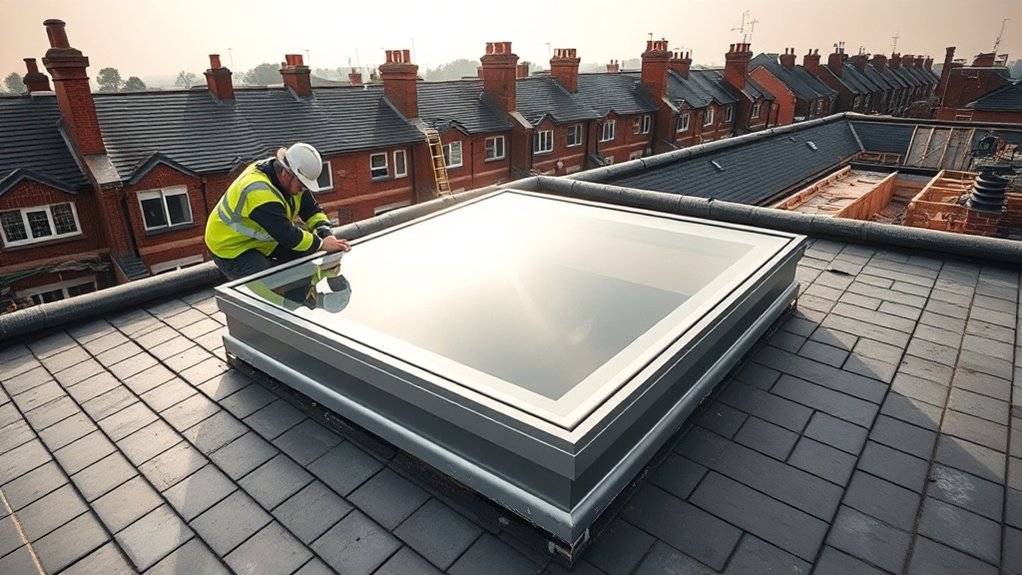
If you’re planning skylight installation in Farringdon, treat it as a structural roof alteration that must meet UK Building Regulations and local council rules. You’ll need structural checks on rafters, compliant roof access and fall protection, and manufacturer-approved flashing to prevent leaks. Choose units with low‑E glazing, insulated frames, and proper ventilation to avoid heat loss and condensation. By following best practice and using competent installers , you can safely gain more daylight and understand exactly what’s involved.
Key insights
- Ensure your skylight design complies with UK Building Regulations and the local council planning rules, especially for conservation areas and permitted development limits.
- Choose the right skylight type (fixed, venting, sun tunnel, or modular) based on room use, roof type, and Farringdon’s weather and overheating risk.
- Hire a Farringdon installer who provides structural assessment, method statements, and is approved by major skylight manufacturers to protect warranties and safety.
- Budget from a few hundred to several thousand pounds depending on unit size, glazing performance, automation, and whether new roof openings or scaffolding are required.
- Prevent leaks and heat loss with BS 5534‑compliant flashing kits, waterproof underlayment, high-performance glazing, airtight linings, and proper insulation around the skylight shaft.
Planning Your Skylight Project in Farringdon
Before you cut into a roof in Farringdon’s variable climate, you need a clear plan that aligns with UK Building Regulations and local council requirements. You’ll start by commissioning a structural assessment to confirm joist capacity, load paths, and any need for trimming or reinforcement. Next, map the skylight’s position relative to fire escape routes , party walls, and protected roofscapes flagged in local planning policy.
You should model daylight factors and potential Solar lighting gains, verifying that increased solar gain won’t compromise summer overheating limits or winter U‑value requirements. Integrate Skylight aesthetics with roof pitch, existing materials, and sightlines from neighbouring properties, documenting everything in scaled drawings . Finally, sequence works, access, and edge protection in a written method statement and risk assessment.
Choosing the Right Skylight Type for Farringdon Homes
Once you’ve outlined a compliant skylight plan for your Farringdon property, you need to match that design with the right unit type and specification. You’ll balance skylight aesthetics , Glass durability, ventilation, and energy performance against local rainfall, wind, and heat‑loss considerations.
Think in terms of functional categories:
- Fixed skylights – maximise daylight while minimising penetrations; specify low‑e, laminated glass for impact and fall protection.
- Venting skylights – add controllable airflow; choose electric units with rain sensors for safety and moisture control.
- Sun tunnels – ideal for tight corridors and internal bathrooms, keeping roof openings compact and low‑risk.
- Modular or walk‑on systems – for flat roofs and terraces; require enhanced Glass durability, tested slip resistance, and certified load ratings .
Roof Structure Checks and Skylight Suitability in Farringdon
Even with a well‑considered skylight specification, you must confirm that your Farringdon roof structure can safely accept new openings and additional loads. Start by having a competent professional assess rafter size, spacing, span , and existing deflection to verify structural integrity before cutting any timbers.
They’ll calculate roof load from self‑weight, imposed loads, and the skylight unit, then check how that load redistributes when you introduce trimmers and cranked or doubled rafters around the opening. Pay special attention to older terraces and properties with previous alterations , where hidden defects or undersized members are common.
You should also confirm the roof’s suitability for your chosen skylight configuration, ensuring adequate bearing, compatible roof pitch, and robust support to resist uplift, creep, and long‑term movement.
Planning Rules and Building Regs for Farringdon Skylights
Before you cut a hole in your roof, you need to confirm the skylight meets Farringdon’s permitted development criteria and doesn’t require full planning permission. You’ll also have to guarantee full compliance with Building Regulations , particularly for structure, weatherproofing, ventilation, energy efficiency, and fire safety. If your property sits in a conservation area or is listed, you must check additional heritage constraints that can limit skylight size, position, and external appearance.
Permitted Development Criteria
Although adding a roof window might look straightforward, you must confirm your skylight meets both national Permitted Development rules and the local council requirements, as well as UK Building Regulations. You’re free to explore advanced glazing, smart controls, and bold skylight aesthetics, but only within defined limits.
Key Permitted Development criteria typically include:
- Position rooflights on the roof slope, projecting no more than 150mm beyond the plane of the roof.
- Keep any side-facing units obscure-glazed and restrict opening to protect neighbours’ privacy.
- Avoid raising the roof’s highest point and respect any conservation area or listed-building constraints.
- Integrate external lines, frame finishes, and potential window treatments so the installation reads as a coherent, low-impact alteration to the existing roof.
Building Regulations Compliance
Once you’ve confirmed your skylight qualifies under Permitted Development, you still have to demonstrate full compliance with UK Building Regulations, as applied by the local council’s Building Control . You must evidence structural adequacy (Part A), ensuring rafters, trimmers, and fixings can resist added loads and wind uplift. Part L requires a compliant U‑value, thermal breaks, and airtight installation to avoid condensation and heat loss.
You also need toughened or laminated safety glass to BS EN standards for Part K, with opening sections designed to prevent falls. For roof rooms, consider Part B fire‑spread limits and smoke ventilation requirements. Coordinate skylight aesthetics and interior design with compliant upstands, insulation thicknesses, and ventilation, so the installation looks minimalist yet remains fully certifiable.
Conservation And Heritage Limits
Even when a skylight meets general Permitted Development criteria, conservation areas, heritage assets, and Farringdon’s local planning policies can sharply restrict what you’re allowed to do. You’re balancing innovation with Heritage preservation, so you must treat the existing roof structure, materials, and sightlines as constraints, not afterthoughts.
Typical conservation guidelines and conditions may require you to:
- Position rooflights on rear or less-visible slopes, minimising impact on the streetscape.
- Specify low-profile, conservation-style units that sit flush with traditional slate or tile.
- Match frame colours and finishes to established heritage materials and detailing.
- Provide detailed drawings, sections, and method statements proving structural safety , fire performance, and reversible installation.
Always confirm whether you need full planning permission and listed building consent before commissioning works.
Step-By-Step Skylight Installation Process
Before you cut into a roof in Farringdon’s variable climate, you need a clear, code-compliant installation sequence that protects the structure and keeps the opening watertight. Start with a structural survey and load assessment, then set out the opening from inside, aligning it with desired skylight aesthetics and existing rafters.
Erect scaffold and edge protection, then use fall-arrest systems for installation safety. Cut the roof deck following the manufacturer’s framing dimensions, trimming and doubling rafters as required by BS 5534 and local building control.
Fix the skylight frame to the structural opening with corrosion-resistant fasteners at specified centers. Integrate the proprietary flashing kit in shingle fashion with the roof covering, then complete interior insulation and vapour control layers before final lining.
Energy Efficiency and Weatherproofing for Farringdon Skylights
With the skylight structurally fixed and flashed to the roof covering, you next need to optimise energy performance and long‑term weather resistance for Farringdon’s damp, wind‑exposed conditions. Focus on U‑values, airtightness, and robust drainage so the unit works as a controlled solar energy collector, not a heat‑loss weak point.
- Specify insulated, low‑e double or triple glazing with high glass durability, tested to BS EN standards for impact, UV stability, and thermal stress.
- Use warm‑edge spacers and argon or krypton fill to minimise perimeter condensation and winter heat loss.
- Detail continuous air‑vapour control layers, taped joints, and insulated upstands to prevent interstitial condensation.
- Apply high‑performance membranes, compatible sealants, and stainless fixings, ensuring laps, falls, and outlets manage Farringdon’s heavy rain and wind‑driven moisture.
Skylight Costs, Timelines and Farringdon Installers
How much you invest in a skylight in Farringdon depends on unit type, glazing specification , roof structure, and whether the work triggers Building Regulations upgrades to insulation or fire safety. Budget ranges typically run from a few hundred pounds for basic domes to several thousand for large structural glass or automated Skylight design with integrated sensors and blinds.
Allow one day for a straightforward replacement, two to three for a new opening in a tiled roof, and longer where steel trimming, external access scaffolds, or internal fire compartmentation are required. When shortlisting Farringdon installers, check professional memberships, Part L and Part B compliance knowledge, written installation safety method statements , and evidence of CDM awareness. Always insist on manufacturer-approved installers to preserve warranties.
Common Skylight Problems in Farringdon Homes and How to Avoid Them
When you plan a skylight in Farringdon’s wet, often cold climate, you must address three critical risk areas: roof leaks, heat loss , and moisture control. You’ll need correctly detailed flashing, high‑performance glazing, and insulation that meets or exceeds current Part L and Part C Building Regulations to keep water and heat where they belong. You also have to design for proper ventilation to manage condensation safely and protect your roof structure and indoor air quality.
Preventing Roof Leaks
Properly installed skylights shouldn’t leak, yet in Farringdon’s wet, wind-driven climate they often do because of poor flashing details , inadequate underlayment, or improper roof integration. To prevent this, you need a skylight design that treats the unit as a critical roof penetration, not a window in the sky. That means integrating daylight optimization with robust moisture management.
- Specify engineered flashing kits compatible with your roof covering and pitch; avoid site-made improvisations.
- Install self-adhered waterproof underlayment up the curb and at least 300 mm beyond all skylight edges.
- Counterflash into the primary roof covering, never just into sealant; sealant is backup, not primary defense.
- Ensure structural curb height and slope meet BS 5534 and local building control for driving-rain exposure.
Minimising Heat Loss
Although a skylight can transform a dark room, it also creates a significant opening in your thermal envelope , and in Farringdon’s cool, damp climate that often means avoidable heat loss and condensation risk. You minimise this by specifying triple- or high‑performance double‑glazed units with low‑E coatings and argon or krypton fill, delivering compliant U‑values under current Part L requirements.
Prioritise insulated, thermally broken frames and warm‑edge spacers so the installation doesn’t become a cold bridge. Detail airtightness with tapes, gaskets, and compatible sealants, then wrap the shaft in continuous rigid or mineral insulation, carefully lapped to existing roof insulation.
Maintain Skylight aesthetics and efficiency through regular skylight cleaning, ensuring solar gain isn’t reduced by dirt that blocks valuable winter daylight.
Condensation and Ventilation
Even with a well‑insulated skylight , you still face a heightened risk of condensation in Farringdon’s cool, humid conditions if ventilation and vapour control aren’t designed correctly. You’re introducing intense natural light at a point where warm, moist indoor air hits a colder surface, so you must manage airflow and humidity to protect your interior design and structure.
To keep your installation compliant and durable, visualise:
- Warm air rising to the skylight, carrying moisture from kitchens, bathrooms, and living spaces.
- Vapour condensing on the inner pane or frame, dripping onto reveals and plasterboard.
- Hidden moisture tracking into rafters, feeding mould and timber decay.
- A balanced system of trickle vents, mechanical extract, and sealed vapour barriers maintaining safe surface temperatures and dry finishes.
Frequently Asked Questions
Can Skylights Be Integrated With Smart Home Lighting or Shading Systems?
Yes, you can integrate skylights with smart lighting and shading systems. You’ll use motorized blinds , dimmable LEDs, and sensors that manage solar energy gain, glare, and privacy concerns in real time. Specify compatible drivers (DALI/0‑10V/Zigbee), weather‑rated hardware, and fail‑safe manual overrides. Make certain controls meet electrical code, fire egress, and safety glazing requirements. You’ll get adaptive daylighting, energy efficiency, and future‑ready automation.
How Do Skylights Impact Indoor Plants and Conservatory-Style Spaces?
You’ll find skylights act like a controlled sunroof for your indoor jungle, greatly boosting Natural light and consistent Plant growth. You design for spectrum, intensity, and duration: specify low‑U, high‑VT glazing, consider UV-filtered glass, and integrate automated blinds to prevent leaf scorch. Guarantee structural loads, condensation control, and safety glazing meet current codes, especially in conservatory-style spaces where humidity, temperature stratification, and access for maintenance all demand forward-thinking engineering.
Are There Acoustic Differences Between Skylight Glazing Options in Noisy Farringdon Areas?
Yes, you’ll notice clear acoustic differences. Higher‑performance glazing materials, such as laminated or acoustic laminated glass, improve sound insulation by decoupling vibrations and damping external noise. Triple glazing or double glazing with wider air gaps outperforms basic single panes. For noisy areas, you should specify tested dB ratings , guarantee compliant edge seals, and use properly insulated kerbs to meet UK Building Regulations while supporting innovative, quiet interior environments.
Can I Add Ventilation Sensors or Automated Rain-Closing Features to Skylights?
Yes, you can, and you’ll wonder how you ever lived without it. You can specify advanced ventilation options using low-voltage actuators, smart controllers, and linked CO₂/humidity sensors for automated indoor-air management. Rain sensor integration allows skylights to slam shut the instant moisture’s detected, protecting interiors. You must use certified hardware, fail-safe manual overrides , and wiring compliant with BS 7671 and manufacturer requirements to maintain performance, safety, and warranty.
How Do Skylights Affect Home Insurance Policies or Premiums in Farringdon?
Skylights can trigger premium adjustments because insurers reassess roof penetrations, glazing specs, and waterproofing details. You’ll avoid surcharges by using BS EN‑compliant units, impact‑resistant glass , and certified installers. Some providers offer insurance discounts for laminated glazing, integrated rain sensors, and monitored security contacts. Always disclose structural changes, keep installation certificates, and photograph detailing. You’ll protect cover validity and position yourself for tech‑driven policy incentives as insurers reward smart, resilient building upgrades.
Summary
When you plan your skylight properly, you’re not just adding light—you’re improving performance. Well‑installed roof windows can admit up to three times more daylight than a same‑size vertical window while still meeting Part L and Part C requirements. By checking structure, following manufacturer specs, using certified roofers, and insisting on Part K‑compliant glazing and documented Building Regulations sign‑off, you’ll get a bright, efficient, and weather‑tight skylight that’s safe for Farringdon’s climate.