
Expect to pay about £400–£800 per fully fitted uPVC casement window in Farringdon, with aluminium, triple glazing, bays and heritage replacements costing more. You’ll need low-U, low-E double or triple glazing, robust weather‑seals and PAS 24 security hardware to suit the city’s damp climate and urban noise. Always use a FENSA/Building Control–compliant installer to meet UK Building Regulations. Next, you can see how styles, materials and installers compare for your property.
Key insights
- Typical fully fitted uPVC casement windows in Farringdon cost about £400–£800 each, with higher prices for aluminium, triple glazing, or complex designs.
- Ensure installers are FENSA-registered or Building Control approved, and that installations comply with UK Building Regulations for safety and energy efficiency.
- Choose styles and materials that suit your property type, such as sash for period homes, bays for 1930s semis, and large casements for modern builds.
- Prioritise energy-efficient double or triple glazing with low U-values, low-E coatings, and good seals to handle Farringdon’s damp winters and reduce heating bills.
- Check installer credentials, itemised quotes, warranties, and reviews, and confirm secure hardware such as multi-point locks and internally beaded glazing.
How Much Does Window Installation Cost in Farringdon?
When you’re budgeting for window installation in Farringdon, you’ll typically see prices ranging from about £400–£800 per uPVC casement window fully fitted, with larger or premium-spec units costing more.
You’ll pay toward the upper band for oversized apertures, bespoke window frame styles, or triple glazing. Aluminium systems generally cost more than uPVC due to higher material and fabrication costs but deliver slimmer sightlines and better rigidity. Complex openings , such as tilt-and-turn or bi-folds, increase hardware and labour input.
Glass tinting, solar-control coatings, and low-E units add to the headline price but can reduce cooling loads and improve overall building performance. Installation overheads also reflect access requirements, scaffolding, disposal of old frames, and compliance with current Part L and F regulations.
How to Choose the Right Windows for Your Farringdon Home
When you’re selecting new windows for your Farringdon home, you need to match performance specs to local climate conditions, especially regarding thermal efficiency and moisture resistance. You’ll assess U-values , solar heat gain coefficients (SHGC), and glazing options to handle Farringdon’s temperature swings and frequent rain. From there, you’ll compare frame materials—such as uPVC, aluminium, and timber—based on insulation, durability, and maintenance requirements.
Assessing Farringdon’s Climate Needs
Although Farringdon doesn’t experience the extreme temperatures of some regions, its mix of cool, damp winters, warm summers, and frequent rainfall means you need windows engineered for both thermal efficiency and moisture resistance . You should prioritise low U‑values to minimise conductive heat loss, and specify high-performance seals and gaskets to combat wind‑driven rain and drafts.
Given Farringdon’s variable solar gain, consider selective coatings and integrated solar shading strategies to control overheating on south and west elevations while maintaining visible light transmission. Optimised glazing ratios and trickle ventilation help preserve indoor air quality without compromising airtightness. Evaluate local noise levels as well, since laminated or acoustic glazing enhances acoustic attenuation, improving comfort in dense urban areas and near arterial routes.
Comparing Window Material Options
Once you’ve defined your performance priorities for Farringdon’s climate, you can compare window frame materials—typically uPVC, aluminium, timber, and composite—based on thermal performance , durability, maintenance, and aesthetics. You’ll balance U-values, structural rigidity, and lifecycle cost to match your property’s exposure and design intent.
- uPVC offers strong insulation and low maintenance, but you’ll rely on internal reinforcement to maintain frame stability on larger spans.
- Aluminium delivers slim sightlines and high structural performance; specify thermally broken profiles to offset its higher conductivity.
- Timber and composite frames provide excellent thermal performance and a premium finish, though they demand higher upfront investment.
Pair your chosen window frame materials with advanced glass types—such as low-e, solar-control, or laminated units—to optimise comfort, glare control, and acoustic performance.
Window Styles That Suit Farringdon Homes
How do you choose a window style that complements Farringdon’s diverse housing stock while meeting modern performance standards? You start by aligning sightlines, opening mechanisms, and glazing patterns with the building’s architectural era. For Victorian terraces and Edwardian villas, vertical sliding sash windows maintain heritage proportions while accommodating high‑performance sealed units and optional acoustic upgrades.
For 1930s semis, bay or bow configurations maximise solar gain and usable internal floor space. Contemporary infill developments often suit large-format casement or tilt‑and‑turn systems, optimising ventilation control and daylighting.
Across property types, you can specify Decorative window grills and stained glass features as integrated units, preserving period character without compromising U-values. Consider trickle ventilation , secure night‑vent positions, and egress-compliant openings to keep designs both future‑proof and regulation-ready.
Best Window Materials for Farringdon: uPVC, Aluminium, Timber
When you’re choosing between uPVC, aluminium, and timber windows for a Farringdon property, you’re really balancing thermal performance, structural rigidity , maintenance requirements, and visual authenticity. uPVC profiles typically deliver the lowest U-values at the most competitive price point, making them popular for energy‑efficiency upgrades in dense urban streets. Aluminium excels where slim sightlines, large spans, and high window frame durability are critical; modern thermally broken systems now rival uPVC for insulation. Engineered timber offers strong structural performance and natural aesthetics, but you’ll commit to periodic recoating.
Consider how each material aligns with:
- Lifecycle costs, including refinishing and hardware replacement
- Integration with advanced glazing, such as solar-control glass tinting
- Exposure to pollution, moisture, and UV that can stress seals and coatings
Replacing Windows in Farringdon Period and Conservation Homes
Managing window replacement in Farringdon’s period and conservation homes demands a balance between preserving architectural character and meeting modern performance standards. You’ll need to survey existing window typology —sash, casement, or bay—and document sightlines, mullion profiles, and decorative glazing patterns before specifying replacements.
Prioritise Historic preservation by selecting profiles that replicate original section depths while integrating high-performance double or slimline units to enhance thermal efficiency and acoustic control. You can use engineered timber or heritage-style aluminium with thermal breaks to achieve durability without compromising aesthetics.
Consider bespoke joinery , putty-line detailing, and authentically proportioned glazing bars to retain visual coherence across the façade. Where feasible, upgrade weather seals, ironmongery, and ventilation components to optimise airtightness and user comfort while respecting the building’s historic fabric.
Farringdon and UK Window Regulations You Must Know
When you install new windows in Farringdon, you must comply with UK Building Regulations, local planning rules, and any applicable conservation constraints . You’ll need to understand key legal requirements on structural integrity, means of escape, toughened safety glass, and adherence to Approved Documents L (energy efficiency) and K/N (safety). Getting this right guarantees your installation meets U-values, ventilation rates, and glazing safety standards that building control and FENSA/Certass schemes enforce.
Key Legal Requirements
Why does window installation in Farringdon involve more than just choosing a frame and glass type? You must navigate statutory controls that govern planning , building compliance, and heritage context. Local planning authorities scrutinise both performance and window aesthetics, especially in conservation areas and listed buildings, where historical preservation drives strict design parameters.
You’ll typically need to evidence compliance with:
- Planning and heritage consent – Required where you alter elevations in conservation areas or listed assets; profiles, sightlines, and materials must replicate or sympathetically reference originals.
- Building regulations sign‑off – Certification via Building Control or a Competent Person Scheme installer.
- Title and lease constraints – Freeholder approvals, covenants, or Article 4 Directions that restrict fenestration changes.
Aligning these legal layers early lets you innovate without triggering enforcement.
Safety And Efficiency Standards
Although design choices are highly visible, window installation in Farringdon is ultimately constrained by hard performance metrics set out in UK safety and energy‑efficiency regulations. You’ll work within Approved Documents K, L, and B , which govern window safety, thermal performance, and fire escape.
Specify toughened or laminated safety glass in critical locations, compliant restrictors on upper floors, and compliant guarding heights to minimise fall risk. For efficiency, you’ll typically target low whole‑window U‑values, low‑E coatings, warm‑edge spacers, and argon‑filled units to exceed Part L baselines.
To optimise installation efficiency, insist on factory‑glazed units, precision surveying, and pre‑commissioned trickle vents. Verify installers self‑certify via FENSA or similar, so performance data, airtightness, and compliance documentation align with future retrofit and smart‑building upgrades.
Energy‑Efficient Windows for Farringdon’s Climate
Because Farringdon experiences cool, damp winters and increasingly warm summers, specifying energy‑efficient windows means focusing on U‑value , solar heat gain coefficient (SHGC), and airtightness to control heat transfer and condensation risk. You’ll want low‑U, low‑E double or triple glazing with warm‑edge spacers and advanced weather‑seals to minimise energy loss and surface condensation.
Select window frame styles that support deep glazing pockets and multi‑chambered profiles, such as high‑performance uPVC or thermally broken aluminium, to reduce thermal bridging . Combine this with targeted glass tinting to fine‑tune solar gain on different elevations.
Key optimisation moves include:
- Low‑E coatings tuned to Farringdon’s heating‑biased load
- Argon or krypton gas fill for improved centre‑of‑glass performance
- Precision installation to maintain continuous airtightness and insulation continuity
Window Security Features That Matter in Farringdon
While high‑performance glazing improves comfort and efficiency, Farringdon homes also need windows that resist forced entry and opportunistic theft. You should prioritise multi‑point lock mechanisms that engage the frame at several locations, reducing sash flex and levering risk. Look for steel‑reinforced profiles, internally beaded glazing, and laminated security glass that maintains integrity even when cracked.
Specify hinges with integrated security claws and anti‑lift features on opening sashes, especially for ground‑floor and accessible windows. Ventilation latches and night‑vent positions must lock positively, not just rest on friction stays. Consider security upgrades such as PAS 24‑compliant hardware, cylinder locks with anti‑snap and anti‑bump protection, and visible yet streamlined handle designs that deter tampering while preserving clean sightlines and contemporary aesthetics.
How to Choose a Reliable Window Installer in Farringdon
When you evaluate window installers in Farringdon, you should first verify their credentials , certifications, and compliance with FENSA or equivalent self-certification schemes. You’ll then compare itemized quotations, ensuring they specify frame materials, glazing specs, labour costs, and installation timelines. Finally, assess warranty terms side by side, looking at coverage duration, workmanship guarantees, and manufacturer-backed product warranties.
Checking Credentials And Certifications
How do you separate a genuinely qualified Farringdon window installer from a risky choice? Start with rigorous license verification . Ask for their company registration number and public liability insurance, then cross‑check these against local authority or government databases. This confirms they’re legally permitted to operate and accountable if something goes wrong on site.
Next, scrutinise certification standards. You’re looking for installers aligned with recognised industry schemes that audit competence, installation methodology, and compliance with UK Building Regulations Part L and F.
Focus on three core credential areas:
- Professional memberships with technical audits and CPD requirements
- Manufacturer-approved installer status for your chosen glazing systems
- Documented training in energy-efficient, low‑U-value, and acoustic-performance installations
Comparing Quotes And Warranties
Once you’ve confirmed an installer’s credentials, you should compare quotes and warranties with the same level of scrutiny, not just pick the lowest price. Assess each contractor’s pricing strategies: are they itemising frame profiles, glazing specs, hardware, labour, disposal, and access equipment, or bundling everything into a single figure? Transparent breakdowns let you benchmark like-for-like.
Interrogate warranty coverage . Distinguish between manufacturer and installer warranties, and check duration for frames, sealed units, coatings, and installation workmanship. Look for transferable warranties and clear procedures for call‑outs, response times, and remedial work.
Challenge vague terms such as “lifetime” or “standard” by asking for written documentation. A slightly higher quote with robust, documented performance guarantees often delivers better lifecycle value than a cheaper, weakly underwritten proposal.
What Happens on Window Installation Day?
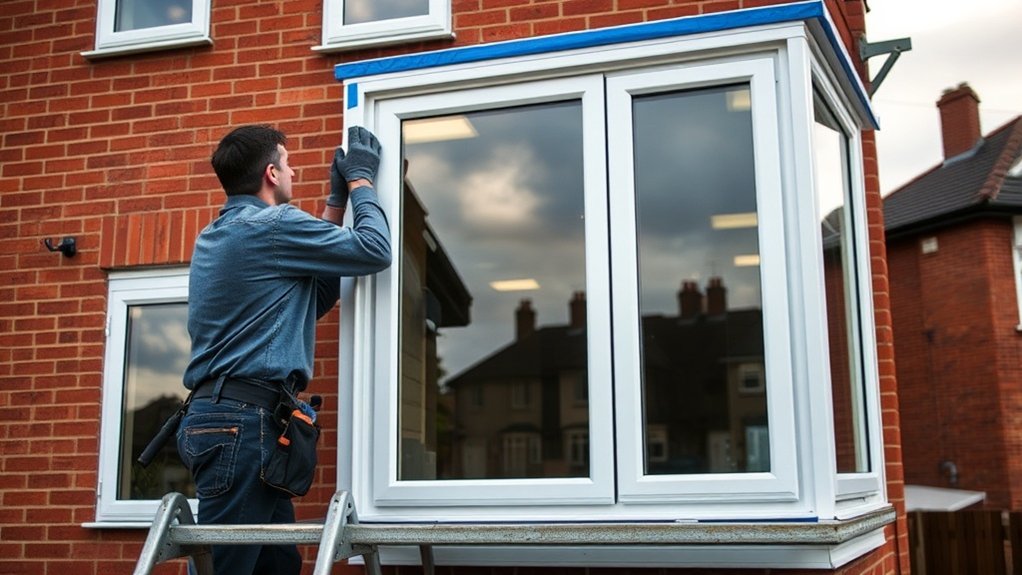
As installation day starts , the crew arrives on site, verifies the work order, and conducts a quick walkthrough to confirm window sizes, locations, and any access constraints. You’ll see protective sheeting go down to shield flooring, and technicians stage tools, sealants, and frames for efficient workflow.
They’ll remove existing units, inspect rough openings for structural integrity, then square, level, and anchor new frames with appropriate fixings. Low-expansion foam and perimeter sealants create an airtight, weather‑resistant envelope.
- Old sashes, glass, and debris are collected for compliant disposal or recycling.
- Glazing, hardware, and sightlines undergo a detailed quality assurance check.
- The team performs initial window cleaning so you can evaluate clarity before reinstalling any window decorations or smart shading systems.
Maintenance Tips to Make Your Farringdon Windows Last
With installation complete and performance verified, long-term results now depend on how you care for your new units in Farringdon’s variable climate. Prioritize scheduled window cleaning using non-abrasive agents and microfiber applicators to protect low‑E coatings and maintain optical clarity. Clean tracks and drainage weep holes so moisture can evacuate and frames don’t degrade.
Inspect seals, gaskets, and sealant joints annually; re‑caulk any failed perimeter beads to preserve airtightness and U‑value performance. Verify hardware alignment, then lubricate hinges, locks, and rollers with silicone-based products to prevent corrosion.
Monitor decorative window trims for paint failure, hairline cracking, or gaps that could channel water toward the substrate. Refinish or reseal trims promptly, ensuring all junctions with the frame remain fully weather‑tight.
Window Installation Problems and When to Repair vs Replace
Even a well-specified window can underperform or fail prematurely if installation defects go unchecked, so you need to distinguish fixable issues from problems that justify full replacement in Farringdon’s climate. You’re looking for symptoms that reveal whether targeted window repair is adequate or if systemic failure demands window replacement.
Typical installation-related problems include:
- Misaligned frames causing sash binding, premature hardware wear, and compromised air-tightness.
- Inadequate flashing or sealant joints leading to concealed moisture intrusion and substrate decay.
- Thermal bridging from poorly insulated cavities, creating condensation, mold risk, and energy loss.
You can often resolve localized drafts or minor water ingress with precision window repair—re-caulking, re-flashing, or sash adjustment. However, recurring leaks, rotten sills, or warped frames usually indicate you’ll gain more by specifying full window replacement.
Frequently Asked Questions
How Does Window Installation Affect My Farringdon Home’s Resale Value?
It can considerably boost resale value because you’re upgrading core building envelope performance. High-spec double- or triple-glazed units improve U-values, enhance Energy savings, and reduce acoustic transmission, which buyers quantify as lower operating costs. Modern frames and sightlines elevate curb appeal , creating a contemporary façade. When you integrate low-E coatings, argon fills, and precision installation tolerances, you signal quality construction, often translating into stronger offers and faster market absorption.
Can New Windows Help Reduce Noise From Farringdon’s Busy Roads?
Yes, new windows can markedly reduce road noise. You contrast chaotic traffic with calm interiors by leveraging soundproofing benefits like laminated glass, argon-filled double or triple glazing, and tight compression seals. You choose window material options—uPVC, composite, or thermally broken aluminium frames—for superior acoustic performance. You also specify correct STC/Rw ratings and professional installation to eliminate flanking paths, creating a quieter, future‑focused living environment.
Are There Grants or Incentives for Installing Efficient Windows in Farringdon?
You can access several financial incentives and government programs for efficient window upgrades. You’ll typically look at schemes like ECO4, local authority grants, and boiler/insulation funds that sometimes bundle high‑performance glazing. You must meet eligibility criteria based on EPC ratings, income, or property type. Installers often manage compliance documentation, U‑values, and certification, helping you optimise payback, leverage innovation-driven products, and integrate windows into whole‑house energy retrofit strategies.
How Do New Windows Impact Farringdon Homes Prone to Condensation and Damp?
They improve indoor conditions by enhancing Energy efficiency and Moisture control . You reduce surface temperature differentials, so moist air’s less likely to condense on glazing and frames. With high-performance double or triple glazing, warm-edge spacers, and low‑E coatings, you stabilise internal temperatures and cut cold bridging. Add trickle vents and proper sealing, and you control vapour pathways instead of trapping humidity. Why tolerate chronic damp when you can engineer it out?
Can I Live in My Farringdon Home During a Full Window Replacement?
Yes, you can usually stay in your home during a full window replacement. Installers phase the work room‑by‑room , maintaining security and weather protection. You’ll need to clear access zones, isolate dusty areas, and temporarily relocate sensitive equipment. Avoid DIY installation on large projects; professional fitting ensures correct tolerances, airtightness, and structural integrity. Afterward, implement proactive window maintenance—checking seals, hardware, and drainage—to extend service life and optimise thermal performance.
Summary
When you plan your Farringdon window installation strategically, you’re not just swapping glass—you’re upgrading the building envelope. By selecting the right glazing, frame material, and installer, you lock in thermal efficiency, acoustic control, and long-term durability. Treat your windows like the lungs of your property: if they’re inefficient or failing, your whole home performance suffers. Invest in quality specification, professional fitting, and routine maintenance, and your windows will perform reliably for decades.