You need fast, secure emergency glazing in Lincoln's Inn Fields that protects people, seals your property, and keeps you operational. Call a 24/7 glazier who can attend within 30–90 minutes, isolate the hazard zone, safely remove loose shards, and board up or fit temporary laminated panels. They’ll document damage for insurance, measure precisely, and schedule full replacement glass with upgraded security where needed. Next, you’ll see what to do right now and what to expect step‑by‑step.
Key insights
- 24/7 emergency glazing in Lincoln's Inn Fields with 30–90 minute call-outs to secure broken windows, doors, shopfronts, and curtain walling.
- On-site temporary boarding or laminated safety panels installed immediately, with full glass replacements typically completed within 24–72 hours.
- Specialists handle toughened, laminated, double/triple glazing, rooflights, and high‑performance units, ensuring safety, security, and energy efficiency.
- Services support vandalism, break‑in, accident, and weather damage, helping maintain business continuity and minimise operational downtime.
- Glaziers can provide detailed reports and photos to support Lincoln's Inn Fields police crime references and insurance claims.
Do You Need an Emergency Glazier Right Now?
How quickly do you need to make your property safe, secure, and weather-tight again? If you’re hesitating, you likely need an emergency glazier now. Any fractured pane, failed seal, or shattered unit instantly reduces structural integrity , invites intrusion, and compromises energy performance.
You should call an emergency specialist if glass is broken, loose, whistling in the frame, or showing progressive cracks. That applies to shopfronts, curtain walling, rooflights, and high-performance units with window tinting or laminated decorative glass.
Don’t wait for “business hours” if you’re seeing sharp shards, exposed edges, or uncontrolled heat loss. A qualified emergency glazier can stabilise the opening, specify like-for-like or upgraded systems, and prepare you for rapid replacement without interrupting your operations.
Why Speed Matters For Emergency Glazing In Lincoln's Inn Fields
When glass fails , you need an emergency glazing response that prevents water ingress, structural exposure, and internal damage from escalating. Acting fast also restores a secure barrier, reducing the risk of intrusion, injury from broken shards, and non-compliance with safety standards. If you run a business in Lincoln's Inn Fields, rapid glazing work keeps your premises operational, minimises downtime, and protects revenue.
Preventing Further Property Damage
Why does rapid emergency glazing in Lincoln's Inn Fields make such a difference to your property’s safety and repair costs? When glass fails, you’re exposed to accelerated deterioration: water ingress, heat loss, and structural movement at window and door interfaces. Fast deployment of temporary or permanent glazing stabilises building envelopes , prevents moisture tracking into cavities, and protects finishes, wiring, and insulation that are costly to remediate.
You also gain precise data for planning works. Technicians can combine immediate make-safe works with targeted property inspections, using moisture meters, thermal imaging, and frame integrity tests. This lets you prioritise repairs, sequence trades efficiently, and avoid secondary failures. Integrated with your existing security measures and maintenance strategy, rapid glazing reduces downtime, insurance risk, and long-term lifecycle costs.
Enhancing Security And Safety
In the crucial first hour after a pane fails, rapid emergency glazing in Lincoln's Inn Fields isn’t just about comfort; it’s a primary security and life-safety control. Every exposed opening increases vulnerability to forced entry, accidental falls, and airborne hazards. You need a team that can assess load paths , impact zones, and access points immediately.
Fast deployment of boarding or temporary glazing restores your façade’s structural continuity and allows you to specify upgraded glass durability and security features at the replacement stage. Technicians can integrate laminated or toughened units, anti-shatter films, and secure fixing systems that resist prying and impact. By closing the breach quickly, you stabilise the environment, control access, and create a safer platform for more advanced, permanent glazing solutions.
Minimising Business Downtime
Because every unprotected opening acts as a functional bottleneck, speed in emergency glazing directly determines how much trading time you lose. You’re not just securing glass; you’re restoring operational continuity, data protection, and customer confidence. Rapid response in Lincoln's Inn Fields’s dense commercial zones means technicians arrive with pre‑configured systems, measure, cut, and install in a single visit.
Quick deployment lets you:
- Maintain environmental control, preventing HVAC losses and product spoilage.
- Preserve brand image with temporary solutions that mirror your decorative glass.
- Integrate future‑ready options, such as privacy window tinting and laminated security glass, in the same call‑out.
- Reduce compliance exposure by reinstating safety glazing to BS and EN standards fast.
The outcome: minimal disruption, maximum uptime, and a resilient, innovation‑ready frontage.
Immediate Safety Steps Before Your Glazier Arrives
Although a professional glazier will stabilise and secure the opening, you need to act immediately to control risk from broken or unstable glass. First, isolate the zone : lock doors to the affected area, post clear “No Entry – Glass Hazard” signage, and redirect staff and customers. Cut power to nearby sockets and illuminated displays to reduce electrical and Fire safety risks.
Next, use cones, barrier tape, or temporary crowd-control systems to define a strict exclusion perimeter. If you’ve got Security cameras , reposition them to capture the breach and surrounding approaches for evidential and insurance purposes.
Don’t touch large shards. Instead, use a brush and pan to lift loose fragments only from safe distances, wearing cut‑resistant gloves and safety eyewear. Dispose of debris in rigid containers.
What To Expect From A 24/7 Emergency Glazier
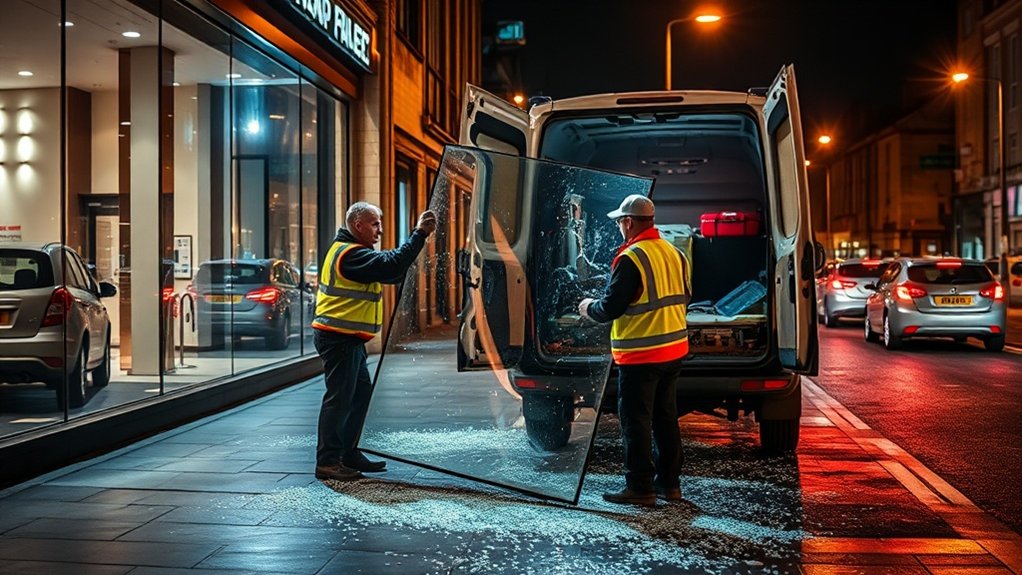
Once you’ve made the call, a 24/7 emergency glazier should respond fast, assess the structural risk, and move methodically to make the opening safe. You can expect a rapid on-site evaluation of frame stability, impact points, and any threats to Glass safety for occupants and passers-by.
They’ll isolate the area, utilise specialist PPE, and apply engineered Repair procedures that align with current British Standards and high-performance glazing technology. You’ll see them document damage , measure precisely, and specify advanced glass types that resist future stress and thermal shock.
- Immediate hazard zoning and secure perimeter setup
- Technical inspection of frame, hardware, and seals
- On-the-spot risk mitigation using professional tools
- Clear briefing on findings, Repair procedures, and next steps
Temporary Boarding Up Vs Full Glass Replacement
In an emergency glazing situation, the critical decision is whether to secure the opening with temporary boarding or proceed straight to full glass replacement . You must balance security, speed, and long‑term performance. Boarding up uses high‑density boards, anchor fixings, and perimeter sealing to restore safety fast and prevent weather ingress or unauthorised access. It’s ideal when you need immediate protection, measurements, and design decisions before committing to new units.
Full glass replacement suits scenarios where you already know the specification and can act in one visit. Here, you should evaluate glass durability under impact, wind load, and thermal stress, plus how framing systems interface with existing fabric. You’ll also weigh aesthetic considerations , ensuring the final installation restores transparency, brand image, and daylight performance.
Types Of Glass Used In Emergency Repairs
Having decided whether to board up or replace the pane immediately, you then need to specify the right glass for the repair, because the wrong choice leaves you exposed to repeat damage, injury risk, and compliance issues. In emergency glazing, you’re balancing glass durability, impact resistance, and window aesthetics under intense time pressure, so you can’t guess.
You’ll typically choose between:
- Toughened safety glass – heat-treated, high strength, fragments into small cubes, ideal for doors and low-level panes.
- Laminated security glass – multiple layers with an interlayer; resists penetration and holds together after impact.
- Temporarily double-glazed units – sealed units that restore insulation while preserving visual uniformity.
- Specialist options – acoustic, solar-control, or privacy glass when performance and appearance must align.
What Affects The Cost Of Emergency Glazing In Lincoln's Inn Fields?
When you’re budgeting for emergency glazing in Lincoln's Inn Fields, you need to understand how the glass type and pane size directly influence material and installation costs. You’ll also see your final price shift depending on response time (day, night, weekend) and how easy it is for engineers to access the damaged area. By knowing these cost drivers up front, you can act fast while still keeping control of your expenditure.
Type And Size
Although every emergency glazing job in Lincoln's Inn Fields feels urgent, the type and size of glass you need will drive the cost more than anything else. You’re not just paying for a sheet of glass; you’re paying for performance, compliance, and precision engineering.
Key cost drivers include:
- Glass specification – Toughened, laminated, acoustic, or fire-rated units cost more but deliver higher safety and performance.
- Enhanced finishes – Window tinting, low‑E coatings, and decorative glass patterns add privacy, efficiency, and style, but increase material and processing costs.
- Unit construction – Double or triple glazing, integrated blinds, or smart-glass technologies require more complex fabrication .
- Panel dimensions – Larger spans demand thicker glass, stronger interlayers, and more robust edge treatments, raising both material and handling costs.
Timing And Accessibility
Glass type and size set the baseline for your bill, but timing and accessibility often decide how steep it gets in an emergency. If you call at 2 a.m. or over a bank holiday, you’re paying for rapid mobilisation , out‑of‑hours labour, and immediate material sourcing.
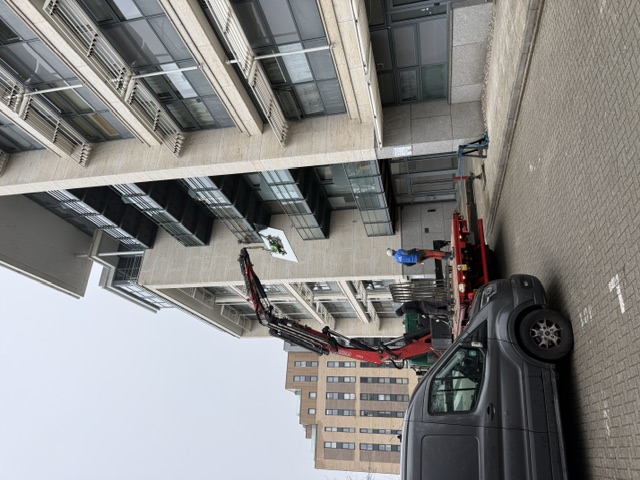
Accessibility drives cost just as hard. Upper floors, restricted rear alleys, or tight courtyards usually need access platforms, specialist lifting gear, and extra operatives. In Lincoln's Inn Fields’s dense urban streets, setup time can rival installation time.
Where window aesthetics or historical preservation matter, engineers must work slower and use non‑invasive fixing methods, especially on listed façades . That precision adds labour, but it protects your asset and keeps you compliant while still restoring security within strict emergency timeframes.
How Long Do Emergency Glazing Repairs Take In Lincoln's Inn Fields?
In an emergency glazing situation in Lincoln's Inn Fields, response and repair times are measured in hours, not days, because security and weather protection can’t wait. A competent team typically reaches you within 30–90 minutes, then stabilises the opening using toughened safety board or laminated panels.
Actual replacement times depend on glass type, pane size, and hardware complexity. Standard double‑glazed units are often turned around within 24–72 hours, while performance options such as window tinting films and decorative glazing panels may add lead time but not delay initial make‑safe work.
You should expect:
- 24/7 call-out and triage within minutes
- On-site securing in a single visit
- Rapid surveying with laser-accurate measurement
- Scheduled return fitting aligned to your operational hours
Insurance, Police Reports And Your Responsibilities
When glass is broken during a suspected break-in, you must report it correctly to the police and obtain an incident or crime reference number without delay. This record isn’t just procedural; insurers typically require it to validate your claim and authorise emergency glazing costs. By coordinating promptly with both the police and your insurer, you safeguard your legal position and ensure your replacement glazing is fully compliant and recoverable under your policy.
Reporting Break-Ins Correctly
Although your first instinct may be to start clearing up broken glass, your priority after a break‑in must be to report it correctly, in the right order, and with accurate detail. Accurate reporting protects your legal position, your data, and your future window aesthetics.
Act methodically, as if you’re running a critical incident protocol:
- Secure people first ; don’t touch the scene or start glass cleaning or temporary boarding yet.
- Call 999 if the intruder may still be present; otherwise use 101 for non‑emergency reporting.
- Record time, damage patterns, missing items, and any CCTV or sensor data for the crime reference number .
- Notify your insurer’s emergency line, then request written confirmation of your report.
Only once police have documented the scene should emergency glazing work begin.
Coordinating With Insurers
Once the police have logged the break‑in and given you a crime reference number , your next priority is to bring your insurer into the loop without delay. Initiate the Insurance claims process via their digital portal or app, uploading the reference number, time‑stamped photos, and video evidence.
You must request explicit authorisation for emergency glazing and keep every invoice. Ask your emergency glazier for a detailed report specifying glass type, locking systems, and temporary boarding methods; this supports a precise property assessment and reduces disputes later.
Cross‑check your policy for limits on out‑of‑hours call‑outs and security upgrades. Share police reports and glazier statements with your loss adjuster in real time, using email or cloud links, so decisions on repairs, replacements, or enhanced security are fast‑tracked.
Choosing A Reliable Lincoln's Inn Fields Emergency Glazier
In a glazing emergency, choosing a reliable Lincoln's Inn Fields emergency glazier becomes a critical safety and security decision, not just a matter of convenience. You need a team that can stabilise risk fast, protect historical architecture, and specify durable replacement systems using eco friendly materials without delaying the initial make-safe phase.
Look for a provider that can evidence:
- 24/7 response with verifiable average arrival times and GPS‑tracked fleets .
- Accreditation (e.g., FENSA, GGF), enhanced DBS checks, and full public liability insurance.
- Capability in laminated, toughened, and security glass, plus digital surveying for precise fabrication.
- Proven experience with Lincoln's Inn Fields’s conservation zones, complex façades, and non-standard apertures.
Confirm they issue detailed job reports, photo documentation, and compliance certificates so you can demonstrate due diligence and plan long‑term glazing upgrades confidently.
Emergency Glazing For Homes Vs Businesses In Lincoln's Inn Fields
Whether you’re securing a terraced home in Holborn or a retail unit on the high street, emergency glazing in Lincoln's Inn Fields demands different strategies for residential and commercial properties. In homes, you prioritise occupant safety, insulation, and visual continuity with historical architecture. Laminated or toughened glass, precisely sized boarding, and PAS 24–aligned locking hardware restore security while preserving façade character.
For businesses, you need faster, more robust interventions. High‑traffic frontages, high‑value stock, and 24/7 operations justify anti‑bandit glass , polycarbonate panels, and reinforced framing that integrate with alarms and CCTV. You’ll also balance environmental considerations: low‑E units, warm‑edge spacers, and argon fills stabilise internal temperatures and control energy costs, while compliant installation protects both your insurance position and long‑term building performance.
Common Causes Of Broken Windows And Shopfronts
Because broken glazing rarely happens by chance, you need to understand the forces that most often shatter windows and shopfronts across Lincoln's Inn Fields: deliberate attacks , accidental impacts, and environmental stress. You’re dealing with brittle materials under complex loads, so even advanced systems can fail suddenly.
Key failure triggers include:
- Vandalism and forced entry: Concentrated blows at lock rails, corners, or silicone joints rapidly overload the pane.
- Vehicle or trolley impact: Low‑level collisions exploit edge weaknesses, especially around door thresholds.
- Thermal shock and wind loading: Rapid temperature swings, poor ventilation, and pressure differentials cause micro‑cracks to propagate.
- Design and glass maintenance issues: Incorrect fixings, poorly finished decorative patterns, and neglected seals let moisture, vibration, and fatigue degrade structural performance until the glass finally fails.
Glazing Upgrades To Prevent Future Breakages And Break-Ins
When you upgrade to toughened or laminated glass, you dramatically increase impact resistance and slow forced entry attempts . You also need to assess and improve locks, hinges, and frames so the overall glazing system performs as a single, secure unit. By acting now to specify higher-grade materials and hardware, you reduce the risk of repeat breakages and opportunistic break-ins.
Toughened And Laminated Glass
How do you make sure a smashed window or attempted break-in doesn’t happen again? You upgrade to toughened and laminated glass designed to outperform standard panes under impact and stress. By aligning advanced glass specifications with current safety regulations, you create a barrier that’s harder to shatter, slower to penetrate, and safer if it fails.
Use toughened glass where you need high strength and thermal resistance ; it fractures into small, less dangerous pieces. Choose laminated glass where you need containment; its interlayer holds shards together and resists forced entry.
- Enhanced impact resistance and load performance
- Multi-layer laminates for targeted security levels
- Acoustic and UV-control options integrated into the interlayer
- Custom thicknesses and tints matched to your risk profile
Upgraded Locks And Frames
Stronger glass only works properly if the locks and frames backing it up can withstand a determined attack. You need high-security, multi-point locking systems, reinforced keeps , and anti-snap cylinders calibrated to your frame material—timber, aluminium, or advanced uPVC composites.
We upgrade frames with steel or hybrid reinforcement, security glazing beads, and tamper-resistant fixings anchored into the substrate, not just the reveal. This creates a single security envelope, not isolated strong points. In Lincoln's Inn Fields’s period properties, we balance Historical preservation and aesthetic considerations with concealed hardware, slimline sections, and colour-matched profiles, so upgrades are visually discreet.
Key Questions To Ask Before Booking An Emergency Glazier
Although broken glass demands a rapid response, you still need to ask a few critical questions before you commit to an emergency glazier. In Lincoln's Inn Fields’s fast-moving environment, you can still act urgently and think strategically. Confirm that the provider can stabilise the opening, secure access, and support long-term window maintenance and aesthetic enhancements, not just a quick patch.
Key questions to ask include:
- Do you offer true 24/7 attendance, and what’s the guaranteed response time to my postcode?
- Are your glaziers qualified, insured, and DBS-checked for emergency callouts?
- Can you supply like-for-like energy-efficient glass and smart-ready hardware in one visit?
- How do you structure costs: callout, labour, materials, and follow-up glazing or frame upgrades?
Frequently Asked Questions
Can Emergency Glaziers Help With Non-Glass Shopfront Materials Like Aluminium or uPVC?
Yes, they can. You’ll find many emergency glaziers trained to work with aluminium and uPVC systems, not just glass replacement. They’ll assess material compatibility, source matching profiles, and restore structural integrity fast. Technicians can realign frames, replace damaged panels, secure hardware, and integrate modern energy‑efficient glazing. You get rapid, engineered solutions that stabilise your shopfront, minimise downtime, and keep your façade ready for future upgrades or smart storefront innovations.
Do Lincoln's Inn Fields Emergency Glaziers Handle Rooflights, Skylights, and Conservatory Glass Damage?
Yes, they do. You can call emergency glaziers for damaged rooflights, skylights, and conservatory glass, including complex double- or triple-glazed units. They’ll secure the opening, assess structural risk, and carry out rapid glass replacement or temporary window repairs to maintain thermal performance and weatherproofing. Using advanced glazing systems and modern sealants, they’ll restore clarity, safety, and efficiency so your space stays protected and operational with minimal disruption.
Is Discreet Emergency Glazing Available for High-Profile or Confidential Business Premises?
Yes, you can request discreet emergency glazing tailored to high‑profile or confidential premises. You get discreet solutions that use unmarked vehicles, low‑visibility PPE, and rapid, phased boarding and re‑glazing. Technicians coordinate with your security team, follow NDAs, and protect data zones and sensitive sightlines. They’ll use advanced laminated and security glass to restore confidential security quickly, minimising disruption, media attention, and operational risk while keeping your brand’s reputation intact.
Can Emergency Glaziers Install Temporary Signage or Branding on Boarded Windows?
Yes, they can. You can request temporary signage and tailored branding options on boarded windows to maintain visibility and customer confidence. Technicians apply digitally printed panels, vinyl graphics, or stencilled messaging directly to the boards during installation. They’ll work fast, follow your brand guidelines, and guarantee materials are weather‑resistant and secure. You won’t just cover a breakage—you’ll turn it into a controlled, on‑brand communication surface.
Are Emergency Glazing Services Available for Listed or Conservation-Area Properties in Lincoln's Inn Fields?
Yes, you can access emergency glazing for listed and conservation-area properties in Lincoln's Inn Fields. Specialists respond fast, coordinate with conservation officers , and use methods that protect historical preservation while restoring security. They specify reversible fixings, like screw-in systems and custom-cut boards, to maintain architectural integrity. You’ll get risk assessments, digital surveying, and photo documentation, ensuring every action’s traceable, compliant, and innovative, without compromising your building’s protected status.
Summary
When a window fails in Lincoln's Inn Fields, you can’t afford hesitation. Call a 24/7 emergency glazier, secure the area, and insist on proper risk assessment, safety glass, and BS EN standards . For example, a local boutique cut thefts to zero after an overnight break‑in by upgrading to laminated security glass and anti‑tamper fittings. If you act fast, ask the right questions, and demand compliant materials, you’ll restore safety now and strengthen protection for the future.